
Bachelor's Program
IBS offers Bachelor’s Degree Program in E economics and Management, and we offer courses in five majors (Economics, Finance, Financial Management, Human Resources Management and Big Data Management and Application) and one Quantitative Finance Innovation Experimental Class.
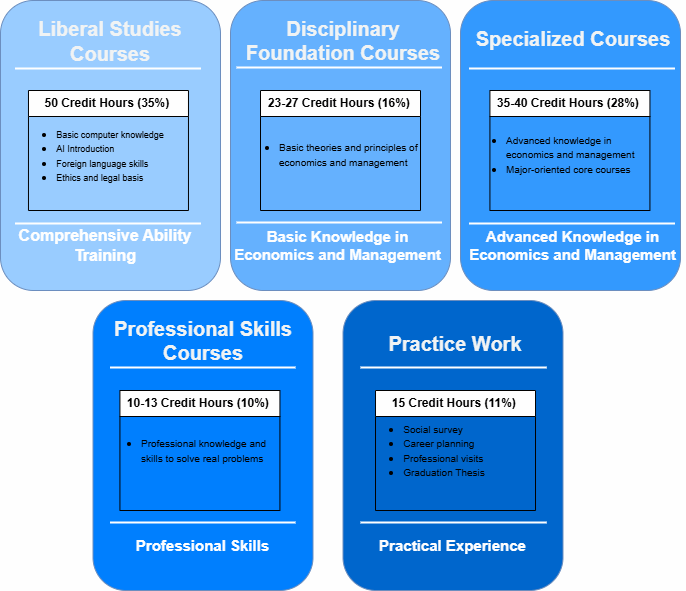
The curriculum framework remains structured around five modules, comprising Liberal Studies Courses, Disciplinary Foundation Courses, Specialized Courses, Professional Skills Courses and Practice Work, following the guidelines of the University’s Teaching Affairs Office and the Ministry of Education.
Liberal Studies Courses (35%) focus on learner’s comprehensive ability training. To keep up with the pace of AI era, Fundamentals of Computer has been replaced by Introduction to AI and Python Programing (This is only the example of adjustment in this module. Other AI courses related to each major are displayed in the following part). By taking these compulsory courses like College English, Ethic and Legal Basis, Theory & Practice of Innovation and Entrepreneurship, learners are expected to acquire basic computer skills, foreign language skills, cross-culture communication skills, innovative skills, knowledge in ethics and awareness of social responsibility.
Disciplinary Foundation Courses (16%) feature the basic knowledge in economics and management that enable learners to understand the basic theories and principles of economics and management. Some of the courses are Microeconomics, Macroeconomics, Linear Algebra, Statistics, Advanced Mathematics, Accounting, Econometrics, Management Theory and Practice of China, which are designed to build a solid foundation that prepares learners for more advanced and specialized coursework.
Specialized Courses (28%) focus on in-depth knowledge and skills within specific business disciplines like Economics, Financial Management, Accounting, Finance, Management Science etc.. Both compulsory courses and elective courses are designed in this module to facilitate learners to gain as much as knowledge related to their majors.
Professional Skills Courses (10%) concentrate on equipping learners with professional skills to face various challenges that may appear in their career path. In this module, learners will take compulsory courses that is more specialized and practical, through which they can learn knowledge and skills that is related to their major.
Practice Work (11%) module consists of Professional Visits and Practice, Social Survey, Career Planning, Graduation Thesis, Labor Education etc., mainly aiming to improve learners’ comprehensive ability to integrate their knowledge to solve real-world problems and gain a strong sense of social responsibility.
Figure 4-1 The Curriculum Structure of Undergraduate Program
All learners are required to earn around 140 credits to obtain the degree, representing a 10% reduction in total credits compared with the curriculum prior to 2024. This change was introduced to optimize the balance between depth and breadth of learning, enhance flexibility for elective and experiential learning.
The program follows a scaffolded learning approach:
• Year 1: All learners are supposed to focus on Disciplinary Foundation Courses and core course like Mathematics, Linear Algebra, Microeconomics, Macroeconomics, Management Theory and Practice of China.
• Year 2-3: Learners could enroll one of the 6 majors of the program namely Economics, Management, Big Data Management and Application, Financial Management, Finance, Quantitative Finance Innovation Experimental Class. During this year, Specialized Courses closely related to the major and Professional Skills Courses are introduced to enable learners get in-depth knowledge, theory and necessary skills to be competent for their future jobs. Except for the compulsory courses, 35 elective courses (including five disciplines) are provided for learners to choose. They have the flexibility to choose courses out of their own discipline to get a wide range of knowledge and skills.
• Year 4: Internship and Graduation Thesis are mandatory to facilitate learners to integrate theoretical frameworks into practical decision-making.