
MBA Program
Master of Business Administration (MBA) Program
The MBA program is designed to cultivate capable corporate managers, strategic planners, and innovative problem-solvers who can address complex management challenges. Consequently, the curriculum emphasizes the integration of practical application and foundational management theories. The program structure comprises four essential components: Core Courses, Elective Courses, Integration and Practice, and the Graduation Thesis. (Please refer to Figure 4.3 for the detailed curriculum structure).
Figure 4-3 The Curriculum Structure of MBA Program
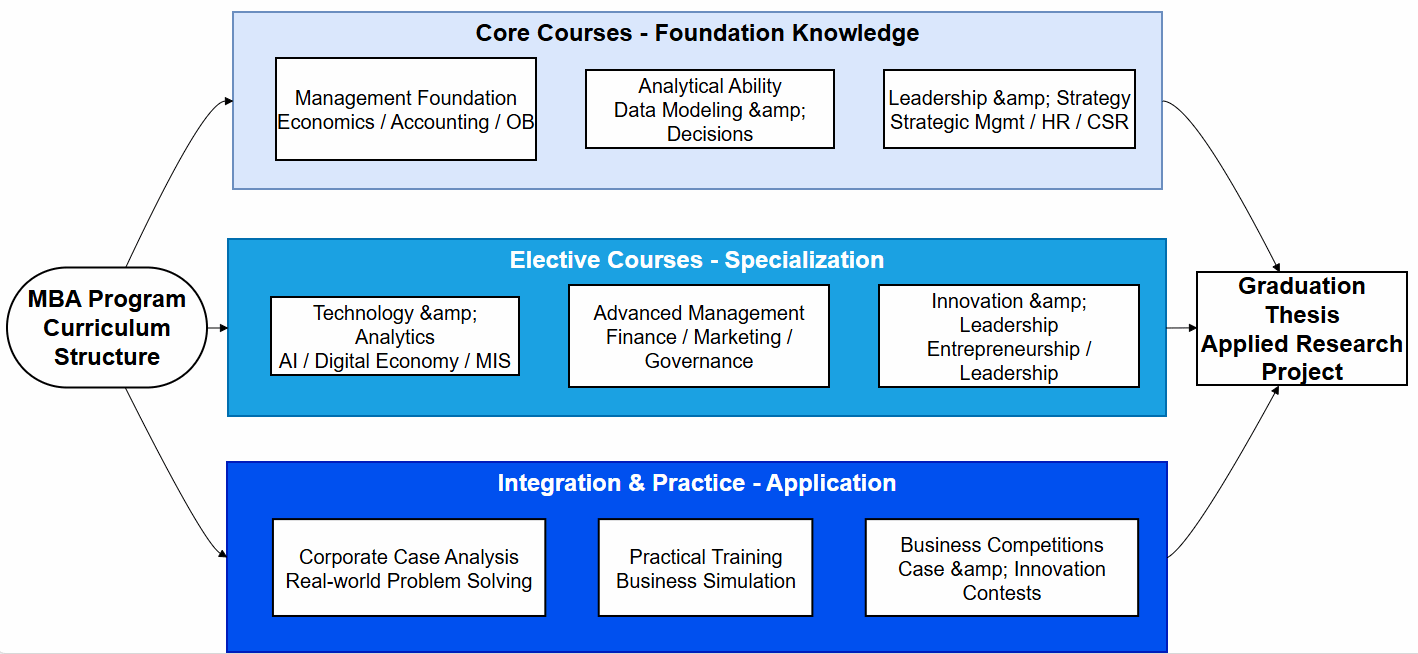
The Core Courses are organized into three thematic modules: Management Foundation, Analytical Ability, and Leadership. These modules collectively provide learners with a comprehensive understanding of essential management principles. Key courses include Strategic Management, Marketing Management, Organizational Behavior, Financial Management, Corporate Social Responsibility and Commercial Legal Systems, among others.
The Elective Courses offer five specialized research directions that reflect current industry demands and innovative business practices:
• Strategy and Leadership- Courses include Operations Management, Innovation and Entrepreneurship Management, and Leadership and Team Management.
• Intelligent Marketing and Brand Management- Featuring Omni-channel Marketing Management, Strategic Brand Management, and Data Mining for Business Decisions.
• Corporate Finance and Accounting- Offering Investment and Financing Management, Risk Management and Digital Transformation, and Intelligent Financial Analysis.
• Organization and Human Resource Management- Including Compensation Management, Management Communication, and Quality Management.
• Educational Company Operations and Management- Covering specific courses on educational institution management.
These elective courses appropriately infuse current and emerging technologies and innovative business theories, ensuring graduates remain at the forefront of management practices. Learners can select courses based on their professional interests and career aspirations.
The Integration and Practice component is crucial for the holistic development of learners’ managerial capabilities. The program offers diverse experiential learning opportunities to enhance leadership, foster innovative thinking, and apply knowledge to solve real-world business challenges. Learners fulfill this component through activities such as:
• Overseas Mobile Classroom provides immersive international learning experiences through the integration of academic courses, corporate visits, and case studies, fostering global management competencies.
• Live-Case requires learners to conduct field research in businesses, identify operational challenges, and develop practical solutions, thereby honing problem-solving abilities in real business contexts.
• Entrepreneurship and Innovation Competitions encourages participation in national-level case competitions and innovation contests, developing creative thinking and strategic decision-making skills.
• Labor Education integrates professional ethics and work ethic development through community engagement and hands-on activities.
Regarding the Graduation Thesis, learners are required to select application-oriented topics relevant to business management practice. The thesis must demonstrate rigorous analysis and practical significance, and adhere to specific formatting standards. It must also pass pre-defense evaluations, plagiarism checks, and anonymous reviews by experts before the final oral defense.