
MPAcc Program
Master of Professional Accounting (MPAcc) Program
The MPAcc program is designed to cultivate high-quality, application-oriented accounting professionals with strong political integrity, leadership capabilities, and a thorough understanding of modern accounting theory and practice. The curriculum emphasizes the integration of professional skills and ethical standards, preparing students to address complex challenges in accounting, finance, auditing, and related fields.
The curriculum is structured into four key components: Core Courses, Elective Courses, Practice and Integration, and the Graduation Thesis. (Please refer to Figure 4-4 for the detailed curriculum structure).
The Core Courses establish a solid theoretical foundation and systematic expertise in advanced accounting principles and practices. This component includes comprehensive coverage through courses such as: Financial Accounting Theory and Practice, Auditing Theory and Practice, Management Accounting Theory and Practice, and Corporate Strategy and Risk Management, Business Ethics and Professional Conduct for Accountants. Additionally, learners receive training in research methodology and academic writing, ensuring they develop both technical expertise and scholarly skills. A strong emphasis is placed on the integration of ethical reasoning throughout the core courses, preparing students for leadership roles in the profession.
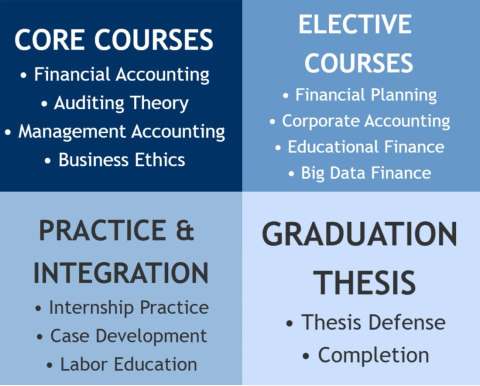 |
Figure 4-4 The Curriculum Structure of MPAcc Program
The Elective Courses are divided into three specialized tracks: Financial Planning and Capital Operation, Corporate Accounting and Risk Control, and Financial Management in Educational Companies. Learners select advanced courses from a wide range of options, including Big Data and Intelligent Finance, Internal Control, Tax Planning, Financial Statement and Business Analysis, and MPAcc Case Writing and Analysis, among others. These courses are intended to deepen learners' professional knowledge, enhance their technical skills, and ensure they remain up-to-date with the latest developments in the accounting profession.
The Practice and Integration component is essential for developing practical competencies. Learners must complete a minimum of six months of internship experience, submitting a practical plan and summary report. The program incorporates a specialized labor education module to foster a strong work ethic and enhance employability. Furthermore, students are required to participate in case study and development activities, which may include field research to develop teaching cases, participation in management consulting projects, or engagement in case competitions. These activities are designed to develop learners’ innovative and analytical skills, enabling them to address real-world challenges.
Regarding the Graduation Thesis, learners are expected to choose application-oriented topics pertinent to accounting practice. The thesis must demonstrate rigorous analysis, comply with specific formatting guidelines, and undergo pre-defense evaluations, plagiarism checks, and anonymous expert reviews before the final oral defense.